The IP platform for the next display layer — IP licensing, no fab.

Next-gen displays for feeling, hearing and sensing.

Acciosonic licenses its pMUT tactile-layer IP to OLED and Micro-LED display manufacturers. Paired with the license, OEMs subscribe to software that lets them activate, manage and update touch, audio and sensing features across entire product lines.

Investment thesis

The Sensory Gap: displays are visual-only.

The pixel is purely visual. Any tactile, audio or gesture function still requires motors, actuators and controllers bolted on as separate external modules — costly, fragile and mechanically constrained. Acciosonic turns this workaround stack into one process-integrated display layer.

Problem

Three modules, three suppliers.

Vibration actuators, speaker modules and proximity sensors sit around the display. The display itself remains blind, deaf and untouchable.

Solution

Haptic Pixel — one layer, three senses.

A pMUT layer integrated into the display renders mid-air haptics, beam-formed audio and proximity sensing in time multiplex.

What is a Taxel

Taxel — the second elementary class of the display.

Pixel renders light. Taxel renders touch, sound and perception. An AlScN-pMUT matrix is integrated into the display stack; each taxel works haptically, acoustically and sensorically in time multiplex.

Haptic pixel

Mid-air ultrasonic haptics, addressable at pixel-level resolution.

Acoustic pixel

Privacy-beam audio from the same layer — directional sound without a separate speaker.

Sensory pixel

Bi-directional: hand and finger proximity, material classification, vital signs.

Cover lens
Pixel layer (OLED / Micro-LED)
Taxel layer (AlScN-pMUT)
TFT backplane (LTPS / Oxide)
Glass / polymer substrate
Pixel renders light. Taxel renders touch, sound, and perception.
Technology

AlScN-pMUT as Taxel-Layer.

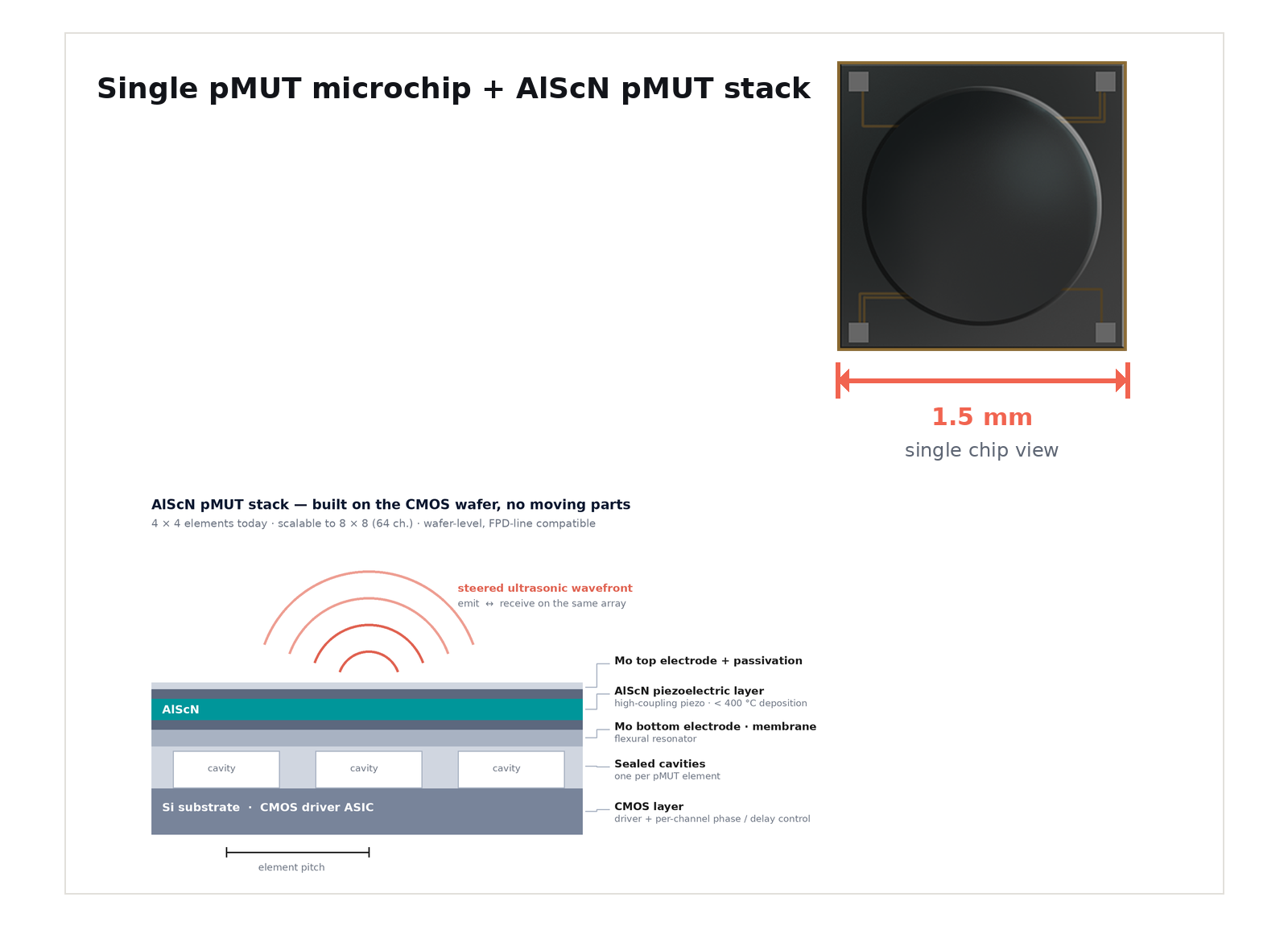
AlScN thin film below 400 °C is compatible with LTPS and Oxide-TFT backplanes. The taxel pitch targets 0.8–1.7 mm, beam steering reaches ±16°, and bi-directional operation supports haptics, audio and sensing without a separate module.

< 400 °C
FPD-line compatible
0.8–1.7 mm
Taxel pitch
20–80 mm
Working distance
± 16°
Beam steering
Gen 2 → 8.5
Substrate scaling
3-in-1
Haptic · audio · sensing
Close-up rendering of an AlScN-pMUT taxel chip with patterned hexagonal actuator cells on a circuit substrate.
AlScN-pMUT taxel array — the actuator layer that sits between the TFT backplane and the pixel layer.
Business model

License + SaaS — the display-IP architecture transferred.

Licensees ship taxel-enabled panels and pay a royalty per panel. Three recurring SaaS axes extend the relationship from process qualification to device-category sensing and haptic authoring.

Process Control Platform

Per FPD line

Process recipes, yield monitoring, line-specific tuning. The first axis, runs from the moment the first licensee qualifies the taxel layer in their fab.

Sensing Library

Per device category

Material classifiers, vital-signal models, proximity profiles — continuously updated subscriptions tailored to AR/VR, mobile, automotive and other device categories.

Haptic Authoring Tools

Per seat

UX designers, game studios and auto-HMI teams design taxel glyphs, audio beams and sensing cues. Unity and Unreal plug-ins, plus a published Taxel-Spec for cross-platform authoring.

First market

AR/VR Micro-OLED — and the sequence after.

AR/VR is the market that needs all three taxel senses at once: haptics, privacy audio and sensing in one stack. Premium device economics tolerate a royalty model first, before the sequence extends into foldable, mobile, automotive and TV / Micro-LED displays.

A user reaching toward an interactive display with mid-air ultrasonic feedback, with a callout showing the underlying taxel chip and circuit board.
Mid-air interaction with a taxel-enabled display — the same layer renders haptics, audio and sensing.
Year 2–3

Foldable Mobile

Premium form factors with high differentiation pressure and rapid iteration cycles. Natural fit for an upgrade layer.

Year 3–4

Mainstream Mobile

Volume scaling. Sub-USD royalty becomes invisible in the BOM once panel volumes cross the threshold.

Year 3–5

Automotive Display

Steering-wheel display as integrative showcase: pixel and taxel on the same surface, in a high-trust deployment.

Year 5+

TV · Monitor · Micro-LED

Large-format and Micro-LED displays at scale, once the taxel spec is established as an industry standard.

Get in touch

Let's talk.

Direct

For licensing, partnership and investor inquiries:

[email protected]

Email Acciosonic


Investors

We are running a pre-seed / seed process. NDAs and data-room access on request after an initial conversation.

Reach the founder →


Press

For media and analyst inquiries, please email directly. We respond within five working days.

Email press desk →

Licensing, partnership, careers

Tell us a little about your context and we will respond personally. Email is the fastest channel.

Every link above opens a pre-addressed email in your default client.